
How to Start a Custom Sportswear Brand in 2027: The Ultimate OEM Sourcing Guide
To start a custom sportswear brand in 2027, pick one clear niche, write a simple tech pack, and partner with an OEM factory that offers low minimum order quantities (MOQs) and fast sampling. Do those three things and you can go from idea to first delivery in about two to three months.
That’s the whole plan. The rest of this guide shows you how to do each part without wasting money.
Sportswear is a good business to enter right now. People buy gym wear, team kits, and sports merch all year. Small brands can compete because factories now accept smaller orders than they did a few years ago. You no longer need a huge budget to get started.
But there are traps. Pick the wrong factory and you get bad fabric, late orders, or colors that don’t match your design. This guide helps you avoid that.
Who this guide is for
This guide fits you if you are:
- A startup founder building a new activewear label
- A gym owner who wants private-label workout clothes
- An esports or sports team manager who wants to sell merch
- A buyer who wants to cut out middlemen and deal with a factory directly
The 7-step launch plan at a glance
- Choose your niche and your customer.
- Define your product range (start small).
- Create a tech pack and a design brief.
- Find and compare OEM manufacturers.
- Order samples and test them.
- Place a small first production order.
- Launch, collect feedback, and reorder.
Each step gets its own section below. You can read them in order or jump to the one you need.
Key terms in plain words
| Term | What it means |
|---|---|
| OEM | A factory that makes clothes to your design and specs |
| ODM | A factory that offers its own designs, which you can brand |
| Private label | Ready-made products sold under your brand name |
| MOQ | The smallest number of pieces a factory will make per order |
| Tech pack | A document that tells the factory exactly how to make your item |
| Sublimation | A printing method that fuses dye into polyester fabric |
Step-by-Step: How to Start a Custom Sportswear Brand
Start with a narrow niche, a short product list, and a clear tech pack. Everything else gets easier after that.
Step 1: Choose your niche and customer
Don’t try to sell to everyone. “Sportswear” is too broad. Pick one group and one need.
Good niche examples:
- Compression wear for CrossFit athletes
- Matching kits for local football and cricket clubs
- Breathable gym tees for fitness studios
- Team jerseys and hoodies for esports squads
- Yoga and studio wear for women
Ask yourself three questions. Who will wear it? Where will they wear it? What problem does it fix? A cyclist needs a jersey that doesn’t flap. A gym trainer needs a shirt that dries fast.
Write one sentence that sums it up. For example: “Sweat-wicking training gear for small gyms that want their own look.” If you can say it in one line, you know your lane.
Step 2: Define a small product range
Start with three to five items. A big range sounds exciting, but it eats cash and splits your orders into tiny batches.
A smart starter range looks like this:
- One hero product (your best seller idea, like a jersey)
- One matching bottom (shorts or leggings)
- One layer (hoodie, jacket, or track top)
- Optional: one add-on (socks, caps, or bags)
Keep sizes simple at first. Order the common sizes in larger numbers and the extremes in smaller ones.
Step 3: Build your design brief and tech pack
A tech pack is the single most useful file you will make. It tells the factory what to build. Without it, you get guesses.
A good tech pack includes:
- Flat drawings (front, back, and side views)
- Measurements for every size
- Fabric type and weight (GSM)
- Color codes (Pantone numbers work best)
- Logo placement and print sizes
- Stitch type and seam details
- Labels, tags, and packaging notes
Don’t have a designer? Many factories will help you build one. Some will also create a free mockup, like Hash International, so you can see the product before they cut any fabric.
Step 4: Find and compare OEM manufacturers
This is the biggest decision you’ll make. The next section shows you how to compare factories in detail.
Step 5: Order samples
Never skip samples. Order one of each item in at least two sizes. Then check them like a picky customer:
- Wash them five times. Does the print fade or the fabric shrink?
- Stretch the seams. Do they hold?
- Wear them while you move. Do they chafe?
- Compare the colors to your design file.
Write down every flaw. Send the list back to the factory with photos.
Step 6: Place a small first order
Use the lowest MOQ that still makes sense. Treat the first order as a test. You want real customer feedback before you spend big.
Step 7: Launch, listen, and reorder
Sell through your own site, your gym, your team shop, or social media. Track what sells. Track what gets returned. Then fix the weak spots and reorder the winners.
OEM vs. Private Label vs. Print-on-Demand: Which Model Fits You?
If you want full control over fit, fabric, and design, choose an OEM manufacturer. If you want speed with less control, choose private label. Print-on-demand works only for testing ideas.
| Model | Control over design | Typical MOQ | Unit cost | Best for |
|---|---|---|---|---|
| OEM (custom manufacturing) | High: your patterns, fabrics, prints | Low to medium | Lower at volume | Brands with a clear design vision |
| ODM / private label | Medium: pick a base design, add your brand | Low | Medium | Fast launches, gyms, small teams |
| Print-on-demand | Low: you choose a blank item and add art | None | Highest | Testing a concept before investing |
Most serious brands start with private label or a low-MOQ OEM run. Then they move to full OEM as they grow.
How to compare OEM sportswear manufacturers
Don’t pick by price alone. A cheap quote with weak quality costs more once you count returns and lost customers.
Use this checklist for every factory you talk to.
| What to check | Why it matters | Good sign |
|---|---|---|
| MOQ | Decides your upfront cash | Clear numbers per style and per color |
| Sampling speed | Slows or speeds your launch | Samples in days, not weeks |
| Printing method | Affects look and durability | In-house sublimation with quality inks |
| Fabric options | Shapes comfort and performance | Several weights and blends, with swatches |
| Tech pack help | Saves you design costs | Staff who review and fix your files |
| Production time | Sets your restock rhythm | A written lead time |
| Shipping | Affects your landed cost | Ships worldwide with tracking |
| Quality control | Protects your brand | Checks at cutting, sewing, and packing |
| Communication | Prevents expensive mistakes | Fast, clear replies in your language |
Questions to ask every factory
Send the same questions to each one. Then compare the answers side by side.
- What is your MOQ per design, and does it change with colors or sizes?
- How long does sampling take, and what does it cost?
- Which fabrics do you stock, and can I get swatches?
- Do you print in-house or send work to another shop?
- What is your standard lead time for bulk orders?
- How do you check quality before shipping?
- What happens if the order arrives wrong or damaged?
- Can you show past work in my category?
A good factory answers these plainly. If replies are vague or slow, expect the same during production.
Red flags to watch for
- No samples offered, or only photos of “previous work”
- Prices far below every other quote
- Pressure to pay everything upfront
- No clear lead times
- Refusal to put terms in writing
- Stock photos instead of real factory pictures
Why direct-from-factory beats trading companies
A trading company sits between you and the factory. It adds a markup. It can also add delays, because your message passes through extra hands.
When you deal with a factory directly, you talk to the people who cut and sew your product. Fixes happen faster. Prices are usually fairer. Look for a manufacturer that shows its own production floor, machines, and team.
One example is Hash International, a custom sportswear manufacturer that works directly with brands, gyms, and teams. Whichever factory you pick, hold it to the checklist above.
MOQs, Costs, Fabrics, and Printing Explained
Low MOQs protect your cash. Good fabric protects your reputation. Sublimation protects your designs from fading. Get these three right and your first collection has a strong base.
What is low MOQ custom sportswear?
MOQ means the smallest batch a factory will produce. A big factory may ask for hundreds of pieces per style. A flexible one may accept far less, especially for sublimated items where there is no need to dye large rolls of fabric first.
Low MOQs help you in three ways:
- You spend less before you know what sells
- You can test more designs
- You hold less unsold stock
Always ask whether the MOQ is per style, per color, or per order. The answer changes your budget a lot.
How to estimate your landed cost
The factory price is not your real cost. Your landed cost is everything it takes to get one piece into your customer’s hands.
Landed cost per piece = factory unit price + shipping per piece + import duties and taxes per piece + packaging and labels per piece + sample and setup costs spread across the orderHere is a made-up example to show the idea. Say a jersey costs $12 from the factory. Shipping adds $1.50, duties add $1.50, and packaging adds $0.50. Your landed cost is $15.50. If you sell it for $45, you keep about 65% before marketing and other costs.
These numbers are only an example. Ask each factory for a written quote, then add your own shipping and duty figures.
Pick the right fabric
Most sportswear uses polyester or a polyester blend. These fabrics move sweat away from the skin and dry quickly. They also take sublimation ink well.
| Fabric | Feel | Best for | Notes |
|---|---|---|---|
| Polyester | Light, smooth | Jerseys, tees, shorts | Great for sublimation |
| Polyester + spandex | Stretchy, snug | Leggings, compression tops | Needs good stitching for stretch |
| Mesh polyester | Open and airy | Basketball and football kits | Extra airflow, light weight |
| Nylon blends | Soft, strong | Yoga and studio wear | Dries fast, feels premium |
| Fleece (poly blend) | Warm, soft | Hoodies, track tops | Check pilling in samples |
Ask for the fabric weight, called GSM (grams per square meter). A higher number means a heavier fabric. Light tees often sit lower. Hoodies and fleece sit higher.
Why dye sublimation works so well for custom sportswear
Sublimation uses heat to turn dye into a gas. The gas bonds with polyester fibers. When it cools, the color is inside the fabric, not sitting on top.
That gives you real benefits:
- Prints don’t crack, peel, or flake
- Colors stay bright after many washes
- Full-body, edge-to-edge designs are possible
- Fabric stays soft and breathable
- Photo-quality graphics and gradients work well
There are limits too. Sublimation works best on white or light polyester. It does not work well on cotton. Dark fabric hides the dye. Plan your colors with that in mind.
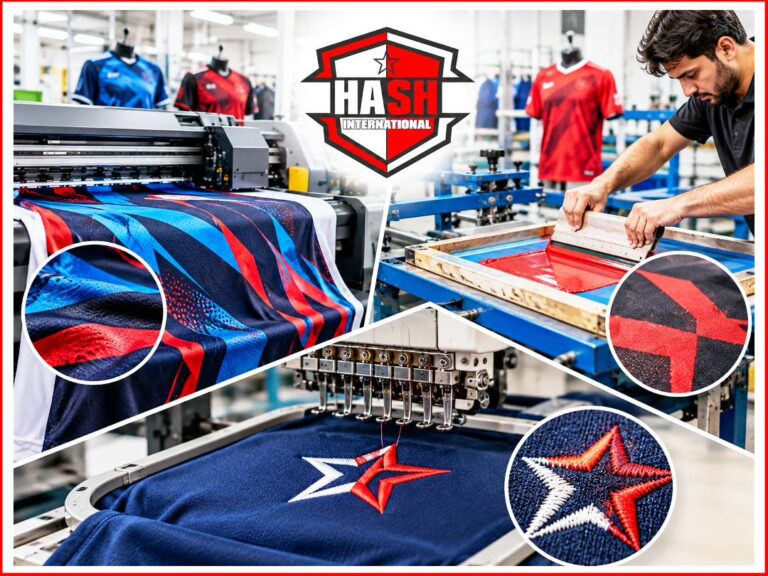
The quality of the printer and ink matters a lot. Italian dye-sublimation equipment has a strong reputation for color accuracy, so ask each factory what machines it uses.
Technical sportswear manufacturing: what makes it “technical”?
Technical sportswear is built for movement. A few features separate it from basic clothing:
- Flatlock seams that lie flat and reduce rubbing
- Moisture-wicking fabric that pulls sweat away
- Stretch panels placed where the body bends
- Ventilation zones in high-heat areas
- Ergonomic patterns cut for athletic body shapes
Tell your factory which sport the item is for. A running singlet and a wrestling jersey need very different builds.
A realistic production timeline
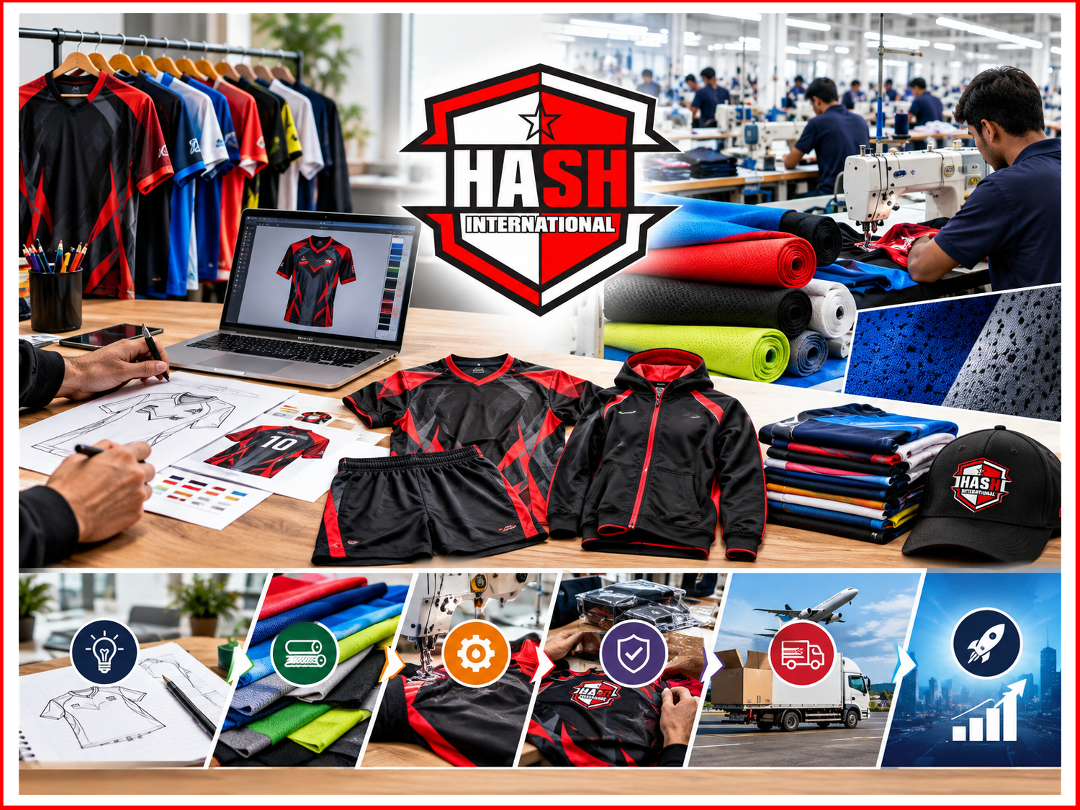
Timelines vary by factory and order size. This is a general path from idea to delivery:
- Design and tech pack: a few days to two weeks, depending on how ready you are
- Mockup and quote: often a few days
- Sample making and shipping: about one to three weeks
- Sample review and fixes: about one week
- Bulk production: varies by order size, with some fast factories finishing within about two weeks
- Shipping: by air, often about one week or less; by sea, several weeks
Ask every factory for its own written lead times. Fast production only helps if quality stays high.
Quality control: three checkpoints
- Before cutting: approve the fabric and the print file
- During sewing: check seams, sizing, and stitch counts
- Before shipping: inspect a sample of finished pieces for flaws, color match, and packaging
For your first order, ask for photos or a short video of the finished goods before they ship.
Start a Custom Sportswear Brand in 2026
7 Steps to Launch
Pick a niche
Keep it small
Write a tech pack
Compare factories
Test samples
Order small
Launch and reorder
Which Model Fits You?
OEM
Private label
Print-on-demand
Factory Checklist
Why Sublimation Works
Great for
Polyester fabricNo cracking or peelingBright, full-body designsNot for
CottonDark fabricBright ink on dark shirtsFrom Idea to Delivery
8 Common Mistakes New Sportswear Brands Make
Most early failures come from rushing. Avoid these eight and you are ahead of many new brands.
- Skipping samples. A photo can’t tell you how fabric feels after five washes.
- Ordering too many styles. Focus on a few strong items.
- Choosing by price only. The cheapest quote often hides weak quality.
- Sending a vague design. Missing details lead to wrong results.
- Ignoring size charts. Fit problems cause the most returns.
- Forgetting shipping and duties. These can eat your margin.
- No brand story. Customers buy a reason, not just a shirt.
- Not planning the reorder. Running out of your best seller costs sales.
Frequently Asked Questions
How much money do I need to start a custom sportswear brand?
It depends on your range and order size. Your main costs are samples, your first production run, shipping, and marketing. A low-MOQ approach lets you start with a smaller budget. Ask for quotes first, then build your plan around them.
What is the difference between OEM and private label?
OEM means the factory builds your own design to your specs. Private label means you put your brand on a design the factory already offers. OEM gives you more control. Private label is faster and often cheaper to start.
Do I need a fashion design background?
No. You need a clear idea and a good tech pack. Many factories help with design files, and some offer free mockups before production.
How long does custom sportswear take to make?
Usually a few weeks from approved sample to delivery. Some fast factories finish bulk orders within about two weeks. Always get lead times in writing.
What is a tech pack, and do I really need one?
It is a document with drawings, measurements, fabrics, colors, and print details. Yes, you need one. It stops misunderstandings and keeps your product the same from order to order.
Can I print on cotton with sublimation?
Not well. Sublimation is made for polyester and polyester blends with a high polyester share. For cotton, factories use other methods, like screen printing or heat transfer.
How do I find a trustworthy factory?
Check real production photos, ask for samples, and compare written quotes from at least three factories. Test their replies for speed and clarity. Start with a small order before you commit to a big one.
Is it better to work with a factory directly?
Often, yes. You avoid middleman markups and get faster answers. Make sure the company really owns or runs the production.
Final Thoughts and Next Step
You don’t need a giant budget to launch a sportswear brand. You need a clear niche, a short product list, a tight tech pack, and a factory you can trust. Start small. Test. Then grow.
Ready to bring your sportswear brand to life? Partner directly with Hash International for Italian dye sublimation, low MOQs, custom tech packs, and 10–12 business day global delivery. Request your free pre-production mockup and factory quote today!